
Brachycephaly

Shortening the soft palate of a pug

Shortening the soft palate of a pug

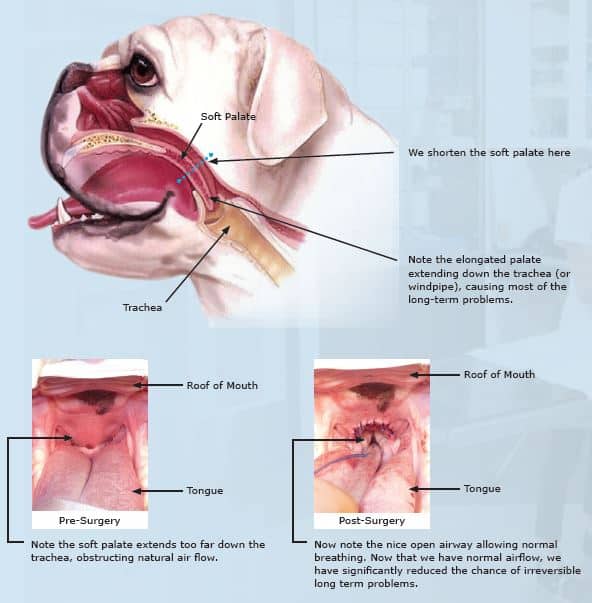
As a veterinarian, I am very frequently asked by pug owners whether shortening the soft palate is a relevant topic for pugs – and if so, when, how, and with what risks. The pug is a brachycephalic breed, meaning it has a short skull. This head shape predisposes pugs to Brachycephalic Obstructive Airway Syndrome (BOAS), in which several constrictions in the upper respiratory tract occur.

A key structure in this process is the soft palate (velum). If it is too long or too thick, it can obstruct airflow, leading to snoring, wheezing, exercise intolerance, coughing, gagging, increased panting, sleep disturbances, and in extreme cases, life-threatening respiratory distress. In such cases, shortening the soft palate (medically: staphylectomy or palatoplasty) is a proven veterinary option to relieve pressure on the airways and sustainably improve your dog's quality of life.

Shortening the soft palate of a pug Read More »

Nasal fold resection in pugs

Nasal fold resection in pugs

As a veterinarian, I am frequently approached by pug owners with the same concern: "My dog ​​squints, rubs his eyes often, and constantly has brown streaks from his tears – could this be due to the nasal roll?" In many cases, the answer is yes. Nasal roll resection in pugs is a targeted, minor plastic surgery procedure in which the protruding, hairy roll of skin (the so-called "nose roll") is removed or reduced so that the hair no longer rubs against the cornea. This constant rubbing – known medically as trichiasis – can irritate the cornea, leading to pigment deposits, chronic inflammation, and even painful ulcers. This phenomenon is part of the so-called brachycephalic eye syndrome, which is very common in pugs. International animal welfare and professional organizations describe in detail how the proximity between prominent eyes and skin folds is precisely what causes the cornea to be repeatedly irritated. ufaw.org.uk+1

Nasal fold resection in pugs Read More »

Dog snores

Dog snores

When your dog snores, many dog ​​owners initially acknowledge it with a smile. A deeply breathing, sleeping dog seems peaceful, and its snoring almost cute. But what if the snoring suddenly gets louder, persists, or becomes more frequent throughout the day?

In many cases, snoring is harmless—but it can also be a sign of structural or functional respiratory problems. This guide will help you better identify the causes and decide when a visit to the veterinarian is necessary.

Dog snores Read More »

Brachycephaly

French Bulldog Diseases

Bulldogs are charming and strong-character companions that are loved in many households around the world. Their unique appearance and friendly nature make them a popular choice for dog lovers. However, their specific physical characteristics also pose particular health challenges. In this article, we will examine in detail the most common diseases that affect bulldogs and provide preventive measures to keep these loyal four-legged friends healthy.

French Bulldog Diseases Read More »

BrachySound

BrachySound – a new study

The study “BrachySound: machine learning based assessment of respiratory sounds in dogs” is an important step in veterinary medicine, especially in the diagnosis of brachycephalic obstructive airway syndrome (BOAS) in dogs. This research, led by a team of experienced scientists, uses machine learning to objectively analyze and classify breathing sounds in dogs. This represents an innovative approach that complements and potentially improves traditional diagnostic methods.

BrachySound – a new study Read More »

Brachycephaly

Questions about brachycephaly

In animals, brachycephaly is the result of selective breeding. Through breeding selection, the skull, particularly the nose and lower jaw, became increasingly shortened. Even adult animals should retain their childlike snub nose. When short-headedness is exaggerated through excessive and incorrect selection, an extreme form of brachycephaly results. With these FAQs we answer the most frequently asked questions.

Questions about brachycephaly Read More »

Scroll up